


Andrew Hanna

Andrew Hanna
At DevOps Cairo 2025 (8th Edition), the focus was clear:
Companies are no longer asking if they should bring AI into delivery and operations; they’re asking how.
The sessions showcased how teams are already using smart automation to remove friction from everyday work:
What struck me most was how practical those stories were - not theory, but real stories coming from companies much like yours, solving everyday bottlenecks with practical tools.
For engineering teams, automation is cutting cycle time and error rates.
For business teams, it’s freeing staff from repetitive admin and improving
responsiveness.
These aren’t just tech upgrades; they reshape time to market, customer experience, and revenue outcomes across businesses.
See how automation removes delivery bottlenecks across Salesforce and multi-cloud stacks.
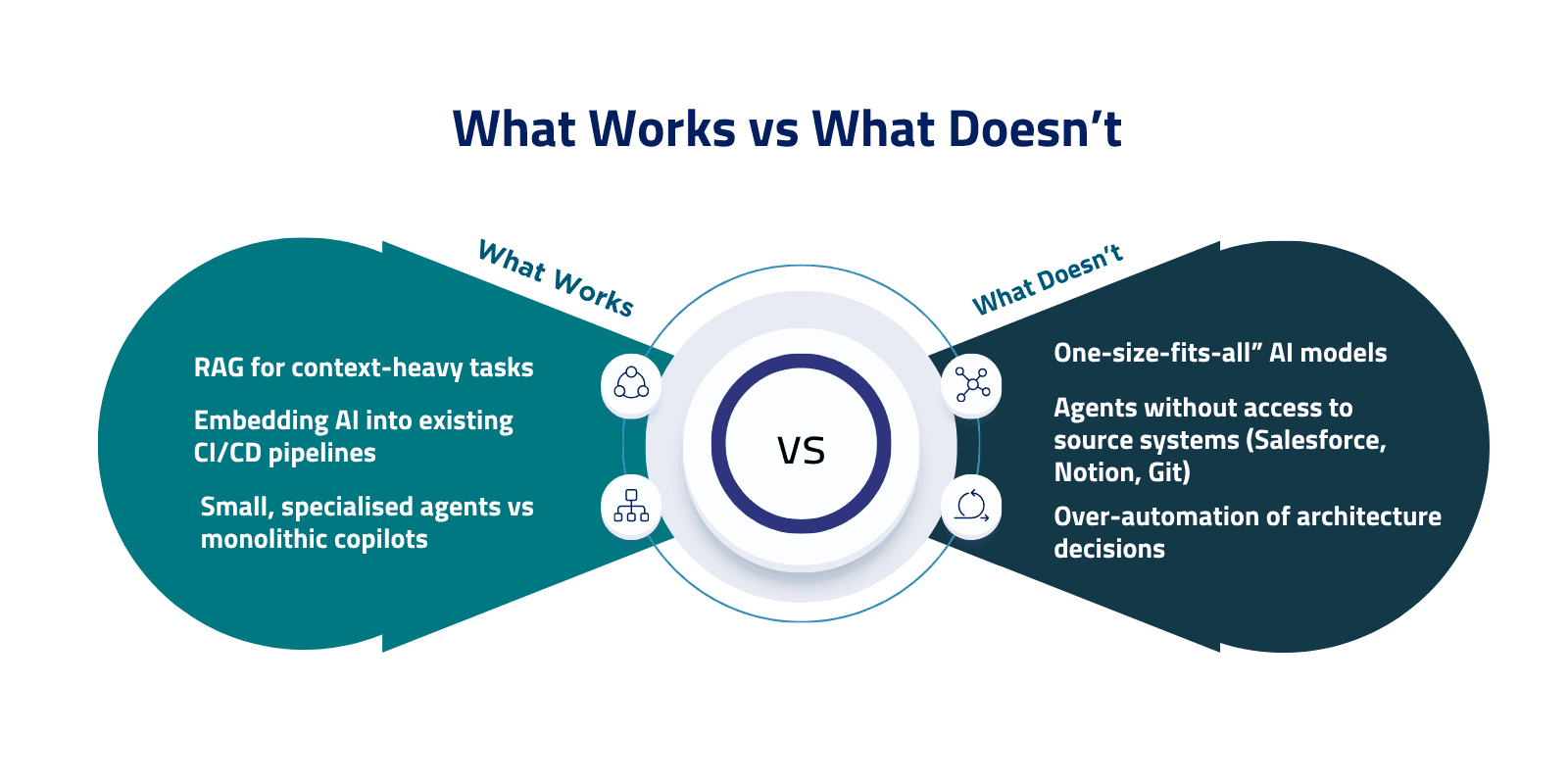
From the technical side, AI is now embedded directly into the DevOps lifecycle, not bolted on as an external copilot.
Real example: shifting from AKS to Cloud Run with StakPak AI + OpenAI Codex automated Kubernetes manifest migration - eliminating always-on staging clusters, simplifying ops with autoscaling builds, and speeding releases via parallel PR validation.
Automation brings speed and risk. Without guardrails, teams face compliance and data-security issues or architectural drift.
Handled this way, automation increases both efficiency and resilience.
We’ve implemented these practices across client projects:
Measured results
Qualify leads, enrich CRM data, and route opportunities automatically, freeing sales to focus on closing.
Where does AI actually help in a DevOps pipeline?
At the repetitive checkpoints. Pre-commit agents flag security issues and metadata dependencies, test-case generators turn user stories into regression suites, and health-check agents validate deployments for version and dependency drift after release.
What makes an AI DevOps agent effective?
Context. Agent logic paired with vector memory gives it awareness of your systems, model enrichment feeds it org-specific data, and CI/CD integration puts it where developers already work.
What are the risks of using AI in DevOps?
Data leakage from poorly scoped prompts, hidden vulnerabilities in auto-generated configs, compliance gaps as change velocity rises, and unstable architectures caused by over-automation.
How do you keep AI automation safe and governed?
Log every agent action so behaviour stays observable, apply policy controls that limit scope and permissions, and keep a human reviewing high-impact changes. Align all of it with the compliance frameworks you already run.
The companies winning with AI and automation aren’t chasing every new tool; they focus on practical, outcome-driven changes.
If you’re considering this for delivery, sales, or customer operations, we’re ready to explore where it creates the most value.
→ Talk to us at Tekunda about simplifying your DevOps and RevOps cycles.
Commitment free!