

Sandbox Seeding
Loading realistic sample or masked data into a sandbox or scratch org so testing reflects real conditions.
Definition
Sandbox seeding is the process of loading realistic sample or masked production data into a sandbox or scratch org so development and testing reflect real-world conditions, rather than an empty or thinly populated org. Salesforce sandboxes can copy production data depending on type, Developer sandboxes copy none, Partial Copy takes a sample, Full copies everything, but scratch orgs never inherit data automatically and always start empty.
Manual seeding usually means data loader scripts, CSV imports, or Apex data factories run by hand after every org refresh, which is easy to skip under deadline pressure and leads to bugs that only appear once real data volumes hit production. Teams managing several orgs through an Environment Hub often bake seeding into their standard refresh routine for exactly this reason.
Seeding also needs to respect data privacy: production data used in lower environments typically needs masking for GDPR and similar requirements, and should be scoped as part of a repeatable deployment plan rather than a one-off script. See our Salesforce DevOps guide for where data management fits into the broader DevOps picture.
How it works in Serpent
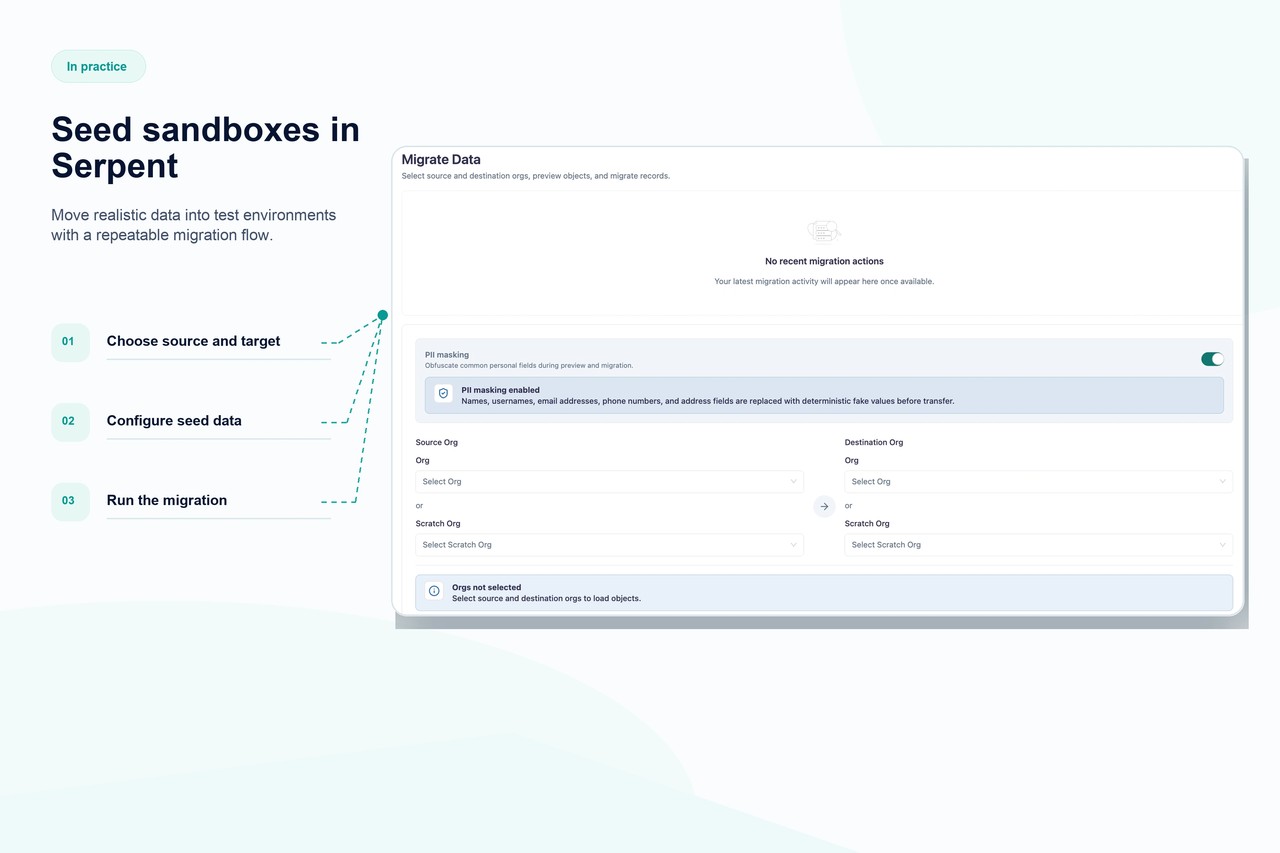
Serpent automates data seeding as part of environment setup and release pipelines, so scratch orgs and refreshed sandboxes come back populated with the right sample or masked data without a manual script run. Seeding steps live inside the same automation that provisions orgs and deploys metadata, so environments stay consistent every time, not just when someone remembers to run the loader. This closes a common gap where bugs only surface in production because lower environments were tested empty. See Serpent automations for how data seeding fits into no-code pipelines.
Sandbox Seeding, answered
Start free. No credit card, no install, no commitment.
Set up in under 15 minutes. No DevOps hire needed.