


Serpent Team

Andrew Hanna
Manual Salesforce deployments are not free; they are unbudgeted. The cost hides in the engineer hours spent hand-building change sets, the release nights that slip, the failed deployments that get rolled back by hand, and the features that ship weeks late. Priced honestly with the four DORA metrics, a team running manual change sets is often the most expensive way to deliver Salesforce.
This is a point of view, not a pitch. If you only ship a handful of small changes a year, change sets are fine. But the moment you have more than a few developers and more than a couple of environments, the arithmetic turns against you fast.
Start with the sticker price of change sets: zero. Now add what the org actually pays to move metadata by hand:
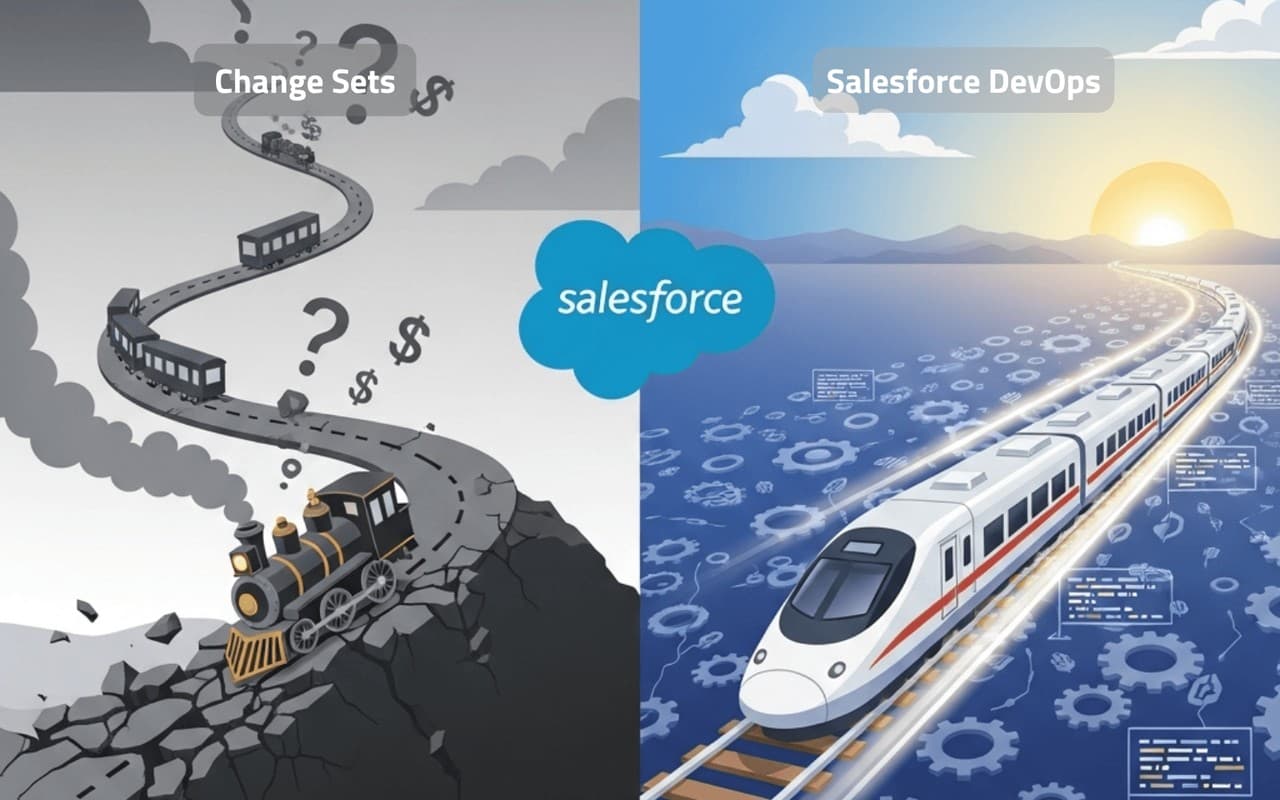
The hidden cost is not the deploy itself; it is everything change sets refuse to do for you. They carry no version control, no automated tests, no pre-deploy validation, and no risk analysis, so every safeguard is a human remembering to do it. They also cannot move some metadata at all, and they force an all-or-nothing approach on things like profiles. Each gap is absorbed as manual labour, and manual labour is where the budget quietly drains.
The deployment step looks cheap. The reconciliation, the rollback, and the release you did not ship on time are the invoice.
Stop arguing from feelings and measure it with the four DORA metrics, the industry standard for delivery performance:
Manual change sets tend to score badly on all four: infrequent releases, long lead times, high failure rates, and slow recovery because rollback is manual. Salesforce teams often add a fifth, deployment time itself, since moving metadata between orgs by hand is the slow step. Put real numbers on these for one quarter and the cost of the manual process stops being invisible. For the wider breakdown of where that money goes, see The True Cost of Manual Salesforce Deployments Explained.
A CI/CD pipeline moves the labour into software. Version control becomes the record of what changed, automated tests and validation run before anything reaches production, and deployments become repeatable instead of remembered. The Salesforce DevOps category exists precisely to close these gaps, with tools like Copado, Gearset, Salto, AutoRABIT, Flosum, and Blue Canvas, alongside newer platforms. They differ in approach, but the shared premise is the same: the manual steps that cost you the most are the ones a pipeline should own.
That is the bet behind Serpent: git-based, automated Salesforce delivery so the expensive manual steps stop being a person's evening. The point is not that change sets are bad; it is that once your team crosses a certain size, doing it by hand is the pricey option, not the frugal one.
Are Salesforce change sets really free?
They have no license cost, but they carry a large operational cost in engineer time, failed deployments, and slow releases. Free to buy is not the same as free to run.
When should a team move off change sets?
Friction compounds once you pass roughly five developers or more than a couple of environments. That is usually the point where automation pays for itself.
How do I prove the cost to my leadership?
Track the four DORA metrics for a quarter. Deployment frequency, lead time, change failure rate, and time to restore turn a vague complaint into numbers a budget owner understands.
Does automation remove the need for release discipline?
No. A pipeline enforces discipline instead of relying on memory, but you still design branching, testing, and approval. It moves the effort from repetitive manual work to one-time setup.
Commitment free!