

Apex Test Coverage
The percentage of Apex code executed by tests; Salesforce requires at least 75% to deploy to production.
Definition
Apex test coverage is the percentage of Apex code lines executed by Apex test classes, and Salesforce enforces a hard minimum: at least 75% overall coverage, with no failing tests, before Apex can be deployed to production, and managed packages typically need higher coverage per class. Coverage is a floor, not a quality signal on its own; tests that execute code without meaningful assertions can hit 75% while testing nothing useful, which is a common trap for teams optimizing for the number rather than the tests. Static analysis is the usual complement, and it is one reason regulated teams end up evaluating suites that bundle it, as the Serpent and AutoRabit comparison covers. Salesforce calculates org-wide coverage across all Apex, so a single well-tested class can mask poorly tested ones elsewhere, and coverage can silently drop below the threshold as new code is added without matching tests. Running the full test suite before every production deployment also gets slow as an org's Apex codebase grows. Our Salesforce DevOps guide covers testing practices as part of a full release process.
How it works in Serpent
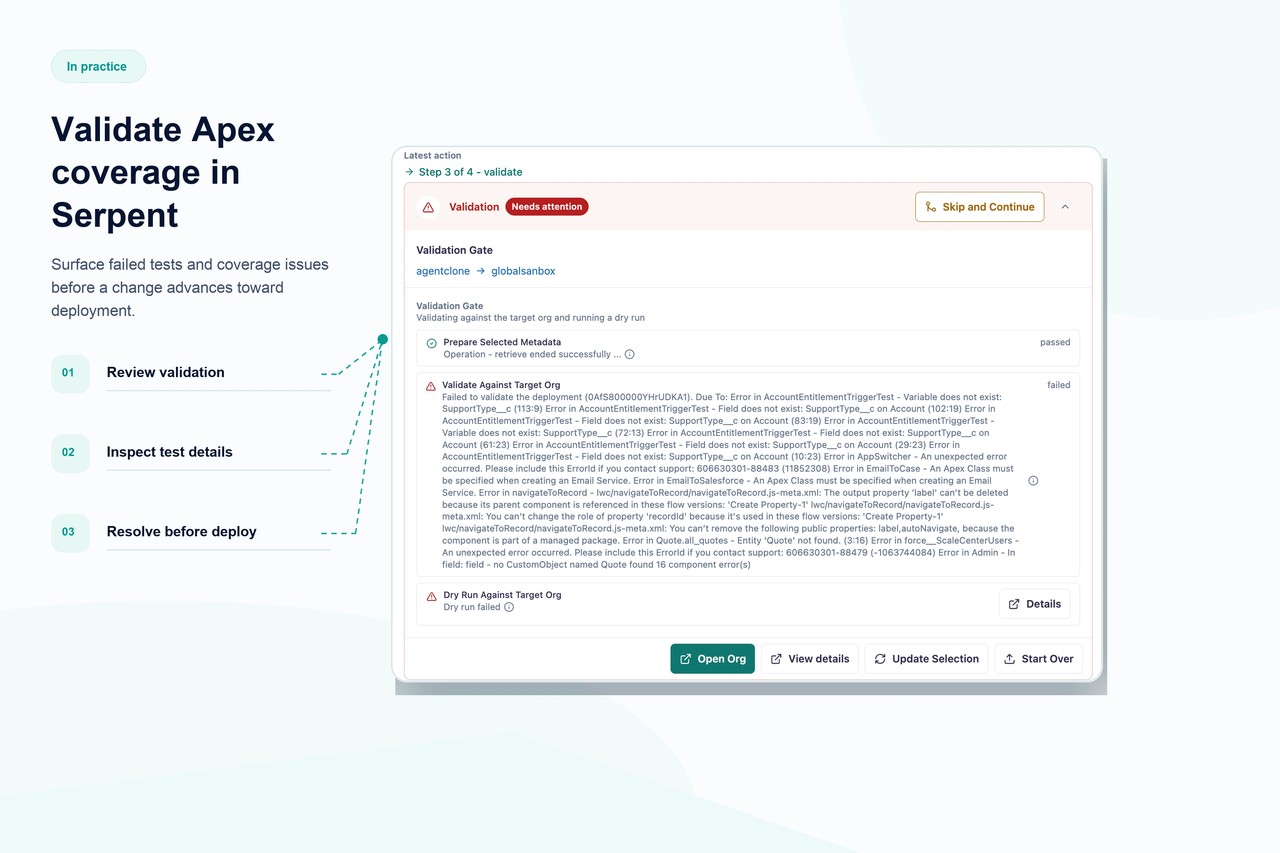
Serpent runs Apex tests automatically as part of the release pipeline, so coverage and failures are checked before a deployment reaches production rather than caught after. Automations can run the full suite or scope to affected tests depending on the release, balancing speed against thoroughness without a manual decision every time. Test results are logged alongside the deployment, so a coverage or failure issue is traceable back to the exact task and commit that caused it. See Serpent automations for how test runs fit into no-code pipelines.
Start free. No credit card, no install, no commitment.
Set up in under 15 minutes. No DevOps hire needed.